Close
Close
 Home
Home
 Reports
 About
About
 More
More


NOT CURRENT YEAR

Solvay
About the company
Grade Summary
Solvay has a large production of hazardous chemicals and data tells us that it is producing 35 problematic substances, including 4 persistent chemicals, which leaves the company without a single point in the first category. Another poor area for Solvay is the Lack of Controversies category, where the Belgian company scores 0 points due to several PFAS contamination scandals and huge penalty fines. Its performance in the Management & Transparency category is also weak. The 6 points Solvay is awarded for its screening process, active marketing of safer alternatives and work to reduce hazardous waste really saves the company from ending up among the worst performers.
Opportunities for improvement
- Solvay currently has 4 substances in its product portfolio belonging to the group of chemicals dubbed “forever chemicals”, due to their extreme persistence. For investors, these chemicals pose a nightmare when the persistence and level of exposure is revealed, as demonstrated by the companies involved in the PFAS disaster, suffering massive financial implications. Investors risk stranded assets, as the environmental and human health impacts of exposure to “forever chemicals” can’t be stopped or easily reversed. For this reason – not to mention for the sake of human health and the environment – we strongly recommend that Solvay prioritises phasing out persistent chemicals from its product portfolio.
- The company should also reduce its hazardous portfolio overall, which currently consists of 35 banned, severely restricted or SIN-listed substances. Chemical pollution has a harmful impact on human health and the environment, and poses a growing threat. Two million people died due to exposure to hazardous chemicals in 2019, compared to 1.56 million in 2016, according to the World Health Organization (WHO). Hazardous chemicals are also key drivers of biodiversity loss, putting entire ecosystems in jeopardy. A good place to start the reduction would be the five PIC substances that Solvay still offers. PIC, short for Prior Informed Consent, is one of the key provisions of the Rotterdam Convention, allowing the export of – often domestically restricted – hazardous chemicals to poorer countries with weaker chemical legislation, as long as the receiving country signs a consent that it understands what it is accepting and has a plan for how to handle it.
- Solvay has an appointed Senior Vice President for Circular Economy and some targets for its circular strategy, but the targets are not time-bound. The company is also participating in a Proof of Concept exercise funded by the EU, but a Solvay product or process with a circular end-of-life concept has not been found. Bio-based products, such as the company’s vegetable-based glycerin, lack information whether the feedstock competes with food production. There is a lot of potential here, if these aspects are clarified.
Category breakdown
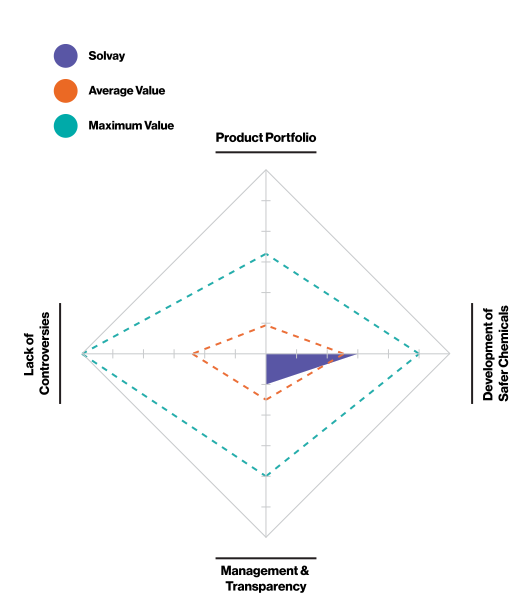

Solvay produces/uses 35 highly hazardous substances – 32 SIN List chemicals, 5 PICs, and 6 HHPs – 13 of which are included on the EU’s REACH Candidate List. 4 of these highly hazardous substances are either banned or severely restricted, with set dates when production needs to cease (4 Authorisation List substances, and no POPs). The company produces 4 persistent chemicals. Persistent chemicals are particularly problematic, since they do not break down, but instead accumulate in humans and the environment. Because of this, persistent chemicals should be of extra concern for investors; substances that are not considered a problem today could become huge liabilities in the future.
Please note that there is no available data for the 43 percent of the company’s production that takes place outside of the EU and US. Lower EU/US production means higher uncertainty with regard to the total production of hazardous chemicals, which will have a negative impact on the company’s score in this category.

Solvay has a method in place to screen and assess the sustainability of its products and includes the intrinsic hazards of ingredients in the screening process. It does not, however, exclude substances with toxic properties from its new products. Solvay actively markets safer alternatives both on its own website as well as on ChemSec Marketplace. The company does not have any true circular products, processes or innovations. Solvay uses bio-based resources, but at the expense of occupying extra land or in competition with food production. It does not source and treat recycled materials in a sustainable way, which is one of the key elements of a circular economy. Solvay is, however, actively reducing the hazardous waste it generates.

The Belgian company does not produce only sustainable products and it does not have a timed phase-out strategy for hazardous substances that go beyond regulatory compliance. It does not share chemical safety information on its website, but it is following a credible code of conduct standard. Solvay did not respond to ChemSec’s attempts to communicate around its ChemScore ranking and it does not share any information about what kind of chemicals it produces in regions with low regulatory demands for transparency (e.g. Asia). Solvay does have a circular economy program in place, but it is lacking objective and measurable circular economy targets.

Solvay is one of many chemical producers struggling with lawsuits connected to environmental contamination by persistent chemicals. According to internal studies, the company has known about severe health risks with the PFAS chemical for at least 15 years, aggravating the situation. There are also other incidents being reported, such as a chemical spill, fires at different plants, and a dangerous gas cloud being released from one of Solvays sites. Over the past ten years, the company paid close to 1.2 million USD in fines for environmental violations according to the violation tracker project of Good Jobs First.
Download Controversies Solvay (PDF, 127 KB)How did we come to this score?
Do you want to know more about our methodology and how we rank the companies at ChemScore?