Close
Close
 Home
Home
 Reports
 About
About
 More
More

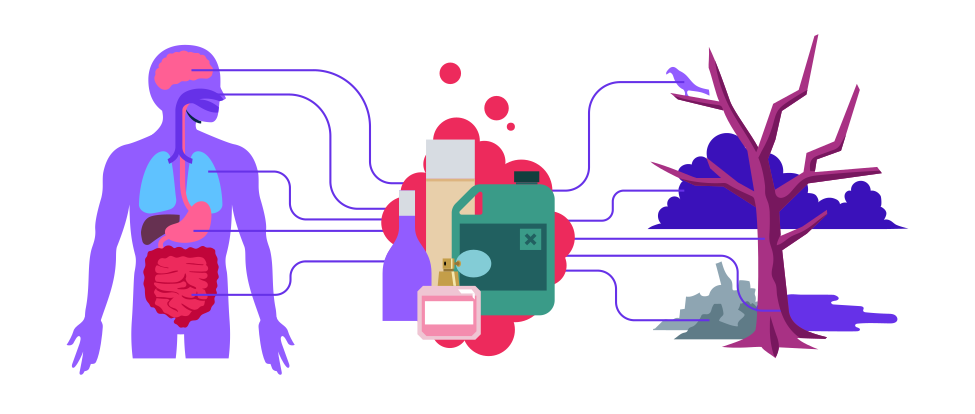
The problem with chemicals
There is little doubt that chemicals play an important role in today’s society. In fact, many would consider them the building blocks of everything we use — from the coating on our phones to the fabric of our clothes. But within those invisible ingredients lie invisible hazards, and the same materials that make our lives easier can also threaten our health and the environment.
It has been estimated that 95 percent of all manufactured goods rely on some form of industrial chemicals. However, exposure to a large share of these chemicals has been linked to adverse impacts on human health and wildlife. For example, in the European Union, 75 percent of the almost 300 million tons of chemicals used annually are considered hazardous to human health or the environment.
These harmful impacts encompass a range of health issues, including cancer, birth defects, obesity, and weakened immune systems. Around nine million people die each year from pollution, corresponding to one in six deaths worldwide, according to The Lancet Commission on Pollution and Health. Investigating the threat of specifically chemical pollution to humanity, a group of scientists concludes: “Anthropogenic chemical pollution has the potential to pose one of the largest environmental threats to humanity.” Chemical pollution is also a key driver of the decline of non-human species and biodiversity.
Moreover, since 99% of chemical production still require coal, oil and gas for feedstock or as a source of energy for the production process, the sector is the largest industrial consumer of energy and the third largest industrial emitter of carbon dioxide.
Chemical production has experienced significant growth and continues to expand at a rapid pace. One way to demonstrate this is by looking at the number of registered chemicals worldwide. In the early 1960s, the number of chemicals listed in the Chemical Abstract Service (CAS) Registry was around 200,000. In 2023, it was more than 200 million, with 10-20 million new registrations each year. Another way to understand the industry’s size is through estimated production volumes. Between 1930 and 2000, chemical production globally increased from 1 million tons each year to 400 million tons.
The production of novel entities is growing so fast that they exceed our ability to assess and monitor their impacts, according to an international group of scientists reviewing the academic literature on chemical pollution. They conclude that “humanity is currently operating outside the planetary boundary” for chemical pollution and novel entities. Despite these warnings, the OECD anticipates a threefold increase in global production of chemicals by 2050, compared to 2010 levels.
Read more: A Profitable Detox (2024)